Tuesday, 12 January 2016

A Spring (or Seven) in One's Step

Well, it seemed like a good idea. A couple of years ago when my sister and hubby were here. they brought with them a rather useful and interesting book called "Walk and Eat Rhodes". I like the cut of its jib, because it's a series of walks that always include a watering hole or eating establishment to make it just that bit more interesting. Good eh?

When they set off home again they left it with us and it's languished on a shelf in my "office" ever since. So, on a gloriously sunny day a couple of weeks ago (on Boxing Day in fact) we decided that it was high time we tried one of the walks for ourselves. Walk number 4 is Arhangelos to Seven Springs (Epta Piges) through olive groves and forest, not using mettled roads anywhere apart from the first hundred metres or so.

In fact, leaving the car just a few metres down the lane from the main road just north of the huge soft furnishing store there, we set off past this olive grove on the lane that leads (if you follow it all the way) to the cemetery, although you branch off of it on to a dirt track before you get that far...

There's a Jay there somewhere, honest!

Now be honest, if you were a dog, the doghouse could be a lot worse.
According to the book, this walk is a circuit of about 12 km, or 7.7 miles, easily within our capabilities and also the timescale we had before darkness was due to fall. The book says the walk takes 3.5 hours, but both of us have long legs and we reckoned we'd do it in less time than that. The book also says that the gradients are easy to moderate and that most of the route follows tracks of one kind or another. Can't go wrong really, eh?

You're soon striking out along a broad single-track lane which is quite level and passes numerous citrus groves and yet more olive groves, occasionally granting one views like these...


This is gonna be a doddle we told each other. A walk in the park. Well, in the picturesque Rhodean countryside anyway. We got into our stride and the terrain soon began to open up a little...

I'm standing at a junction where the book tells you to take a right. The route seemed to be working out OK
All the while for the first hour or so it's uphill, but only gradually, along a gently meandering track, with no really steep sections, making it a leisurely walk in hot sunshine. Since it was December 26th, we didn't expect to see a soul on this predominantly rural walk. But by the time we'd reached the junction in this photo, which is also the one below, but a bit closer, we'd already been passed by two pick-ups, a young couple on a scooter and several other walkers. Seemed like the usual scenario we used to remember in the UK. After a whole day at home falling out with other family members, a lot of people are desperate to get out of the house on boxing day.

Reaching the first real test of the accuracy of the instructions in the book (there is a map too, which is OK but not brilliant), which was a right turn down a steeply descending track, we were quite confident that this was going to be easy. Easy peasy in fact. Maybe even easy peasy lemon squeezy. Well, OK, maybe not that last one. But as we descended we were mega-impressed by the scenery. It is breathtaking. Steeply wooded hills hid secret groves of fruit or olive trees with birds of prey circling above. All in all up until now we were dead pleased with ourselves. We'd left the car at around 12 noon, fully expecting to picnic at Seven Springs before continuing around the rest of the route to get back to the car for around four-ish. At that time of year the sun sets at around 5.20pm, with darkness following quite soon afterward.


Looking at the map in the book, as we approached Seven Springs we decided that we'd probably complete the route in something like two and a half hours, deciding that the book must be designed for the extremely leisurely walker if it estimates three and a half. Arriving at a deserted Seven Springs, where there was actually a small car parked on the terrace that's normally covered in tables and chairs during the tourist season, we were instructed to cross the bridge below the restaurant area and then strike left up through the majesty pine forest, following the steeply sided valley in which the seven springs actually rise.

Yup, even here the Russians are coming!

If you're familiar with this place in summer, you'll find this quite a contrast.


Once you get a couple of hundred metres up along the valley on the other side of the bridge, that's when you start to wonder if this was such a good idea. The instructions are a little vague and you find yourself scrambling up a very steep hillside, occasionally stepping over boughs, scrambling around boulders and reaching forks in the tiny, steep path every few minutes, at not one of which does the correct route seem to be obvious to you. After we'd all but decided to turn back, we arrived, after quite a strenuous and occasionally alarming climb, at a small plateau sprinkled with olive trees which seemed to match the description given in the book. 

"Yup," we congratulated ourselves, "We must still be on the right track." We still hadn't stopped for lunch, which was jiggling around in the rucksack on my back all the while, since it was only around 1.30pm and we though we'd get a little further before seeking out a nice place to park our bums whilst hopefully enjoying a spectacular view.

After the small plateau containing the olive grove we rose a further few metres up a rocky  slope and all of a sudden we were confronted by a wide plain of olive groves, stretching off in all directions. There were fenced-in areas here and there, but whichever way you looked the land stretched into the distance until falling away, obscured by literally thousands of olive trees.

The instructions in the book tell you to follow a low stone way for about a hundred metres and then it says, and I quote, "Strike off diagonally right across the olive grove."

Now, seriously, 'diagonally' if you're standing where we were, could have meant any one of ten directions, the landscape all looked the same at this point. So there was nothing for it but to pick a direction and set off. After ten minutes of nothing looking right, we re-traced our steps.

"Right, then," We told ourselves, "It has to be this way then." Off we set once again. And, once again, after half a mile or so of similar terrain, nothing seemed to match the description in the book. After skirting a "low hill" on the left we were supposed to pass a [quote] "fountain dated 1996."  Frankly the only man-made things around for miles were chainlink fences and a few old stone ruins of cottages long since abandoned. 

I'll not beat about the bush. After another half an hour wandering around and fearing that we'd end up going much too far in the wrong direction, we did begin to worry a little. The location we were at was probably the furthest point on the whole walk from the start-finish point. Nothing in the landscape was making any sense and the sun was fast descending toward the West and the shadows were lengthening. We were both starving and thirsty but there wasn't even anywhere to sit down, just endless meandering tracks amidst thousands of olive trees.

Now, if you're used to walking in Greece you'll know that goats usually give you a very wide berth. It can be quite frustrating in winter time, because all the herds have really cute 'ickle' babies running around keeping close to their mothers and you just want to molly-coddle one or two. You can't usually, however, get to within fifty metres of the blighters before they all run off into the undergrowth, or to the nearest knoll where they then stop and turn around and glare at you with that, "Huh! Try getting up HERE why don't you, eh?" smugness on their faces.

Up where we were at this moment though, the goats that we were encountering would wait until you were within an arm's length before sauntering off just a little further. No panic, no running and bleating. You know what this means though, right? These particular caprines (impressive, eh? Isn't Google wonderful?) don't get an awful lot of human contact. They don't see anthropoids that often it seems. This reaction on their part only served to further raise our alarm level. I began to seriously think that we'd end up still wandering the hills as darkness fell and then we'd be in deep poo, literally as well as figuratively as it happens.

Of course, the very fact that I'm typing this tale takes all the suspense out of it, because we obviously did survive to tell it. But when we were safely back home and heaving huge sighs of relief and taking comfort in a medicinal gin and tonic or two, I decided to Google Earth the area which, had I known how things would turn out, I ought to have done before we undertook the expedition. I'm not kidding, but it's a near impossibility to make out the route even scanning the satellite images. All the way from Arhangelos to Seven Springs one could trace the route we took. As for seeing the route from then on for a good 5k or so, may as well been looking for a snow drop in summer on Rhodes.

Starving and thirsty, we nevertheless finally decided that, if we were to make it back to car before dark, there was nothing for it but to double back and find our way down through the pine forest to Seven Springs, where, assuming we made it, we knew we'd at least have a wall to sit on to eat our egg and tomato rolls before heading back the way we'd come.

Even finding our way back to that small olive grove on the plateau just below the high plain where we'd been wandering about in a daze, proved to be difficult. Why is it that if you turn around and head back in featureless landscape, nothing looks quite the same? Frankly, more by luck than judgement we chanced upon the landmark in question and once again were soon scrambling down slippery, damp steep, pine-needle-covered slopes to the bridge at Seven Springs (what did the book say again? Oh yes... "easy-to-moderate" Yes, well, if you're a mountaineer that would be about right). All the while when we'd been up on that high plain we'd seen no signs of human life at all. If we'd wanted to ask the way, the  best we could have done was to hope to speak goat.

Once back at the restaurant area of Seven Springs we ate a much needed lunch under that cathedral of pines and listened to the peacocks calling.

Hobbit country I'll be bound!

Phew, almost back to the Seven Springs restaurant terrace.

"Oh, you and that ruddy camera!" She said, affectionately.
Tracing our way back the way we'd come we were once again reminded of the steepness of some of the route. Boy did our hamstrings ache the following day...

It's a darned sight steeper than it looks, trust me.
Well, I suppose it all ended OK. We got back to the car before anyone called a search party and it was still in daylight. Next time we plan to try the route from the opposite direction.  After all, there are a few goats up there whom we promised to look up next time we're passing.

Sunday, 3 January 2016

Brrrrr

Well, whilst November and December brought us clear skies and warm weather, leading to us swimming in the sea right up until a few days before the festivities, we're now quite glad that we nevertheless continued gathering wood for the log-burner, because we've just "enjoyed" the lowest temperatures that we've witnessed in ten years on the island.

When people ask me what a Rhodean winter is like, my usual reply is that it's like a good British summer. By and large that's a pretty good description of our winters, yet just now and then we get what I'd call a "cold snap", when freezing cold air from the Ukraine and Russia is brought down across the Black Sea and Turkey to afflict us with frigid temperatures. These are usually lows of around 5 or 6ºC, with daytime temperatures hovering in maybe the lower teens, but this past two days we've dipped well below that. In fact, driving home on Friday evening through Lardos, where we dropped off a friend on our way, the car registered -1.5ºC outside. A first. Plus, yesterday it only managed a measly 10º in the middle of the day. Like the title of the post says, Brrrr! (Did I put enough "r"s in there?)

It did cause us some amusement then, to be watching a TV show from the UK where the presenter was talking to a couple about their wanting to move out to the Paphos region of Cyprus, which has a climate very similar to ours. The couple were shown three different properties to see if any of them would tempt them to part with the readies. Of course, as per usual in these programmes, they wouldn't make a decision. But what caused us a degree of amusement was that in each of the properties the couple were shown a log-burning stove in the lounge area. The couple seemed to think that these, whilst nice to look at, would be a bit surplus to requirements, surely. More than once they said that they expected to be living in shorts and t-shirts most of the time, dining outside and so forth.

Yea, well, OK. It's true that at any time of the year it's a possibility. But the couple seemed to be suffering from what we all used to suffer from before we did our homework, the "Isn't it always hot and sunny out here?" syndrome. Anyone considering making the move would do well to either visit at least once during the winter months, or definitely talk to locals and get the low-down on what kind of weather we can experience from time to time from November through March.

The presenter, Anita, who was recently a celebrity contestant on "Strictly Come Dancing" (and flippin' good she was too. That bolero - phew!) actually tried to make the point that it can be raw on occasion during the winter, but the couple didn't really seem to want to hear it.

A rude awakening awaits, one can't help wondering.

They also, as part of the 'research' done on their behalf by the programme, were taken to meet another couple from the UK who'd been out there for some years and were (yup, you guessed it) helping out at a dog sanctuary. During their little natter the subject of the language came up and it was so much like what we hear here on Rhodes very often. The woman from the couple considering the move commented to the effect that one of her worries about moving out there was the potential language difficulties. They were assured by the couple already living there that this wouldn't be a problem. All the Greeks love the British and they're very friendly too. The fella actually said something like:

 "As long as you make the effort with the occasional Kalimera or efharisto, it goes a long way". Sorry and all that, but it did sound rather patronising of the Greeks. It was a bit like saying, 'keep the natives happy, you know.'

I do confess to being slightly frustrated at a lot of British living out here. It's not like they're really busy or anything. To learn Greek only requires determination and a little motivation. Time is seldom an issue. Laziness though, well, shoot me down in flames (and some will) but I'd say that's the main problem.

"Ah, but," as indeed the couple living on Cyprus did say, "Talk to them in Greek and they'll reply in English anyway."

True, but that's not because they don't think you should learn Greek. It's because they want to practice their English. I've yet to meet a Greek who didn't applaud my having taken the trouble to learn the language. I often try and put the shoe on the other foot. I know what we Brits think about foreigners living in our country who don't learn English. Right, eh?

Anyway, no good soapboxing is it. Sorry. But it is a bit of a bee under my bonnet, as you'll have guessed, no doubt. Being deadly serious, the Brits often don't seem to notice that they're 'colonising' villages and creating British ex-pat 'ghettos' that the locals become more and more resentful of. It's understandable isn't it? Making more of an attempt to assimilate would go a long way towards assuaging the build-up of that resentment.

I keep telling myself, "John, you're a guest in their country. Treat them with due deference." Learning the language has brought a huge amount of friendship and respect from Greek friends that we've made here. It's always going to be worth the effort.

Changing the subject slightly. We took a long walk all around the perimeter of Pefkos yesterday (Saturday Jan 2nd). It was about 10ºC and mainly cloudy. In fact my wife had one of those rare opportunities that only happen two or three times in a winter, that of wearing her long winter coat. We even wore our gloves! Pefkos at this time of the year is a world away from what it's like during the season. As it was cold and, of course January 2nd, the place was nigh on deserted and it was a really enjoyable walk. That's when I snapped this with my phone...


You even get a glimpse of the better half in her winter coat!
And finally. I'm not going to say "happy new year." Know why? because I'm an old pedant, and to me the number on the calendar changes every single day. Why not say "happy new day, week, month" too? Who thought up this calendar we're using anyway? Some sixteenth century pope by all accounts.

I do, though, sincerely wish happiness, prosperity and good health to everyone. I would wish such things on you at any time, any day. Spread a little positivity and it'll come back to you in time. 

And don't be minding an old curmudgeon like me!

Tuesday, 29 December 2015

Spina-wrong-a Part the Second

The island is visible through the restaurant seating area.


At the small café on the front in Plaka, there was one customer. It was a man, a rather portly man who was probably in his sixties and evidently a regular. I tell a lie, across the other side of the path there were tables under a canopy where two other people were sitting, one puffing away at a cigarette. Neither seemed to be interested in us.

I tell another lie. It’s not a café, it’s a taverna, and one with two names apparently. Its sign reads “Taverna Plaka Giorgos Giovanni’s” - Take your pick. Maybe they get a lot of Italian tourists, I don’t know. Anyway, this man soon gave us a cheery “kalimera” and so we trotted over to him. He was fiddling with a mobile phone. Times have changed. Once upon a time it would have been a komboloi.

After we’d exchanged a few pleasantries, he asked us what we were doing, evidently expecting us to say that we wanted to make the crossing to the island. Of course we didn’t disappoint him and so he asked us how many of us there were. We replied that we were just the two of us, but that down on the jetty there was a French couple and also there were the two German ladies who were mooching about nearby. 

“Ooh, at least six of us,” we replied, hopefully.

“Hold on then,” he said, “I’ll make a call.” And he did. He was soon talking to someone at the other end who apparently runs a boat that makes the crossing to Spinalonga and was telling him “Yes, some tourists here want to visit the island… About six, seven at least… Yes, they’re here now.”

He waited while the bloke at the other end made his excuses, all the while glancing occasionally at us with a look that said, “Don’t get your hopes up”, whilst his eyes rolled upward slightly.

After the person at the other end had talked a while, he added, “Yes, of course they’re willing to pay.”

‘Ooer,’ I thought, ‘…Could be costly this. Personal service and all that.’ My wife gestured to get his attention, so he looked her way and she said: “Our friend. Well, no, our friend has a friend, I think he’s called Tassos. He used to work here. He’s an archeologist or something. He told us… well, no, he told our friend, that there are crossings to the island off season, at least on Saturdays and that’s why we came today. it’s our only chance. We’ve come a long way. The weather’s perfect…” She was right on that score. But the man, who evidently had been trying to get his pal on the end of the phone to hear this too, raised his head slightly in that tell-tale Greek backward nod that says, uh oh. He placed the phone back to his ear.

Another minute or so passed before he hung up, placed the phone back the table beside him and said, “He won’t come.”

“Really? But we were told that there would be boats. There would…”

“If you were here last Saturday, there were boats. But they’ve stopped for the winter now.”

Great eh? 

Ah, well, there was nothing for it but to have a little further stroll around Plaka and then make for Elounda and then Agios Nikolaos. Seeing the island up close and personal would have to wait for another year. But before we could leave a young chap appeared at the door of the taverna and asked us where we were from. He spoke perfect English, explaining to us that he’d been schooled in the UK, although he hailed from Plaka. Not that we’d spoken to him in English at all but, like so many Greeks, he wanted to practise his English on us and he did so. Not that he needed practise. I even detected a regional accent from the UK in his speech!

Whether he was hoping that we’d take a seat and order a coffee I don’t know, but he was nice enough and, after a natter of five minutes or so we made our excuses and headed back to the car.


TTFN, then "island". Maybe next time...

Before we reached the car, the two German ladies that we’d seen approached us and asked, 

“Do you know if there will be boats? To the island?” 

Why they were asking us wasn’t too clear. As I’ve often said, although my wife looks Greek enough, I look more like one of their countrymen than do quite a few of their countrymen. We explained what had just gone on around the corner, which anyway they’d been observing from a distance and they were as disappointed as we were. We’d actually followed them along the coast road from Elounda earlier and surmised that they were off-season travellers hoping for what we’d hoped for. Their little Japanese car had the name of the hire company emblazoned on each of the doors. A dead giveaway. Turns out they were friends and were staying with other friends in Heraklion. They, like us, love the islands when the tourist hordes aren’t in evidence.

After we’d wished them a happy remainder of the stay and they’d slumped off dejectedly, we hopped into Tim’s car and made our way back to Elounda. Of course, it never occurred to us until much later that the two women would have thought that we’d know what was going on since the car we were driving is very obviously not a hire car and looks very much like it’s owned by locals. You know what I mean, liberally sprinkled with scrapes, bumps and cracks in the bumpers. Never thought about that at the time.

Elounda has a pleasant enough harbour area, but we weren’t so impressed by the buildings, which seemed to us to be quite modern. It has the Kefallonia feel about it. We decided though on balance that we could have had a nice holiday there. After a brief stroll along the front, we made off to Ag Nik. where we so wanted to see the bridge and the lake.

Have you been to Agios Nikolaus (various spellings, we know!)? It had been on our “to do” list for years, after all those fabulous photographs one keeps seeing showing the outer “port”, the bridge and the inner lake. TBH, when we got there and found a place to leave the car, then began to explore we missed it first time around. It all seemed to us to be much too small. I had the impression that the harbour and lake were pretty huge, when they’re actually not much larger that a couple of tennis courts. Mind you, once we’d adjusted to it and eventually come to realise that the bridge was in fact the one we’d been seeing in all the photos, we found that we really liked the place. Once again, all the photos of the area seem to be taken from a height. When you actually walk on ground level it comes as a shock to see how steep the streets are that lead away from the waterfront.

Anyway, by now it was well past frappé time and so we plonked ourselves down on a pavement table outside the Asteria Café/cake shop and ordered. Thus the photos that now follow…

Elounda harbour.

Still Elounda. or was this Ag. Nik? help!

Frappé at the Asteria, Agios Nikolaos

Taken from upstairs at the Asteria.

Ditto.

Umm, ditto again.

That's the Asteria, across the way, to the left of the bridge.

Of course, while we were sitting there a woman sauntered past with a little dog on a lead and a couple of newspapers under her arm. The Daily Mirror was one of them.

Hey ho, ex-pats are everywhere, eh?


The lake, which is reputed to be bottomless, hence the dark colour of the water, whilst it's quite blue in the harbour outside.

We'd crossed the bridge twice before realising that it was the one in the photos.


Monday, 21 December 2015

Lazy I know, but...

While I beaver away not only at my new novel, but also at part two of the Spinalonga story, Here's a post mainly of photographs which hopefully will hit the spot for lots of Grecophiles...


This is the rather impressive Farangi Gorge, juts a few miles north of Ierapetra. I know, I thought it was named after an alien race in Star Trek too.

Words can't quite capture the grandeur of the palace at Knossos. All excavated by an English chappie too, Sir Arthur Evans.

See what I mean?

Yea Tim, nice portico, needs a decent patio set though...

Two models on a shoot? Well, I wanted to score a few points.

The rather delightful Agios Nikolaos off season. Loved it, but it was all a bit smaller than photos I'd seen had led me to believe.

Not a bad place to sit for one's morning Elliniko.

The sea front at Myrtos.

Ditto. Incredibly, there was one bar open. A group of what we concluded to be German ex-pats were sitting on the promenade sipping their drinks as the sun went down.

Archetypal Greek caique shot at Sitia. Good calendar photo I thought.

Vai. They came in search of paradise.

The beachfront restaurant at Vai. A bit of an understatement I thought.

Sea front at Ierapetra. Late November. Good eh?

The Old Kastro on the sea front at Ierapetra. Quite a surprize.

Ierapetra sea front again. Two blocks down from our friends' place. That's some of the wife's hair on the left by the way. Just in case you were wondering.
Mandraki, Rhodes, just last week. Ugly maybe, but a virtually brand new chic charter cruiser, called Tortoise. Google it. If you've a couple of million to spare you can hire it for a week or so.

I stuck this on the "Novels" Facebook page recently. Literally snapped it as we were walking past. In the old town of course. Experts will recognise it. I love this shot. Looks rather Français, oui?

Click to enlarge. The aaah factor. Near the beach road at Kiotari a few days ago.

Don't tell me you don't know where THIS is.

...or this.

Thursday, 17 December 2015

Horsing About

Many, many years ago I used to frequent Bath Folk Club, when it was held every Sunday evening in the skittle alley out the back of the Ring o Bells pub in Widcombe. One of the artistes who'd play there probably about once a year was called Mike Absalom and he was brilliant. I am amazed to find that he's still going and nowadays paints (rather exquisitely as it happens) and also works as a children's entertainer. I am also glad to see that Bath Folk Club still functions and now meets not a stone's throw away from the Ring o Bells at Widcombe Social Club on Widcombe Hill.

Bear with me here, all right? See, I mention Mr. Absalom (who nowadays looks uncannily like Uncle Albert from "Only Fools and Horses", which is dead appropriate when you consider the theme of this post. Synchronicity or what?) because a rather earthy joke he once told between songs still sticks in my mind to this day, probably some 40 years later and it goes like this (excuse the language, but it works best with the original wording that he employed):

"How do you keep the flies out of yer kitchen?"
"Keep a bucket of shite in the hallway." (dunno why, but I picture horse manure in that bucket, hence the tale. Not the "tail" of course, that would be silly)

Aha! There you have the link to what this post is really about. The stuff that comes out the back end of a horse. Don't worry (as if you were anyway, eh?), part 2 of the Spinalonga story is waiting in the wings and will follow shortly, but something that happened just yesterday has to be related because it just goes to prove what a little gem I have in the woman I'm married to.

The soil in our vegetable patch is exhausted. It's dusty, yellow and in summer dries to such a hard consistency that the only way to get into it is with a pickaxe. A garden fork won't touch it, it's that hard. When I first "dug" it over (mainly with said pickaxe) and planted it up some eight or nine years ago it did manage to produce a couple of seasons of half-decent vegetables, notably some French beans, red onions, beetroot, aubergines, peppers, lettuce and a couple of other things as well. This was probably owing to the fact that prior to the house being built the land had lain fallow for a long time. By the time I'd planted it up for a third time though, full of expectation and eagerness to see my veg grow and grow and some day arrive on our table, it was decidedly awful and the crops deteriorated to the point where I gave up planting anything. Well, I have to admit that the occasional lettuce still manages to grow in it, quite why I've no idea. I have to plant them though because my friend and horiatis Mihalis from Kalathos hands me a plastic bag full of red lettuce seedlings annually and gives me that look that suggests that I may come to some harm if I don't put them in.

Of course, I've considered various ways of enhancing the soil. I've left it a season or two and then dug in the weeds and planted it up in the hope that it would have recovered through being allowed to rest. Nah. No good. Well, no good for the veg, the weeds had a great time re-establishing themselves.

I've talked to various Greeks in the area about the best way to boost the soil and been told that the best manure is goat manure. Have you ever SEEN goat manure? It's comprised of little pellets not much bigger than those left by a rabbit. Either most goats are severely constipated, or rabbits have watery eyes every time they do a no. 2.

And how in tarnation is one going to collect enough to make an appreciable difference to the soil? I am told that at certain times during the winter months, if one sits in the kafeneion up at Asklipio one may be fortunate enough to encounter some bloke with a pick-up who drifts in now and again to advertise the fact that he has sackfuls of the stuff on his flatbed and he's prepared to sell it. I can't imagine how much he must charge, but considering the man-hours involved in filling a sack with the stuff it'll probably require drawing out a lot more cash than the "capital controls" here currently will allow.

Probably be cheaper to buy some Moroccan (know what I mean? nudge, nudge) than the goat manure on the back of that pick-up truck.

When I ask a Greek about using horse manure the response is often "Ooh, no. Burns the soil. Goat is much better. If you use horse then you have to leave it to 'season' for quite a while before you can put it on." 

The things is though, our old friend Dimitri "the horse" (see the books in the RFR series for more about him) has had some of the horses he uses for tourists to ride along the beach on during the season tethered in our valley of late and they have, of course, been depositing generous quantities of their poo within walking distance of the garden. I also know from past experience in the UK that, despite the dire warnings to the contrary that I receive from some local Greeks, horse manure is nevertheless well useful as a means of enriching one's soil for growing stuff.

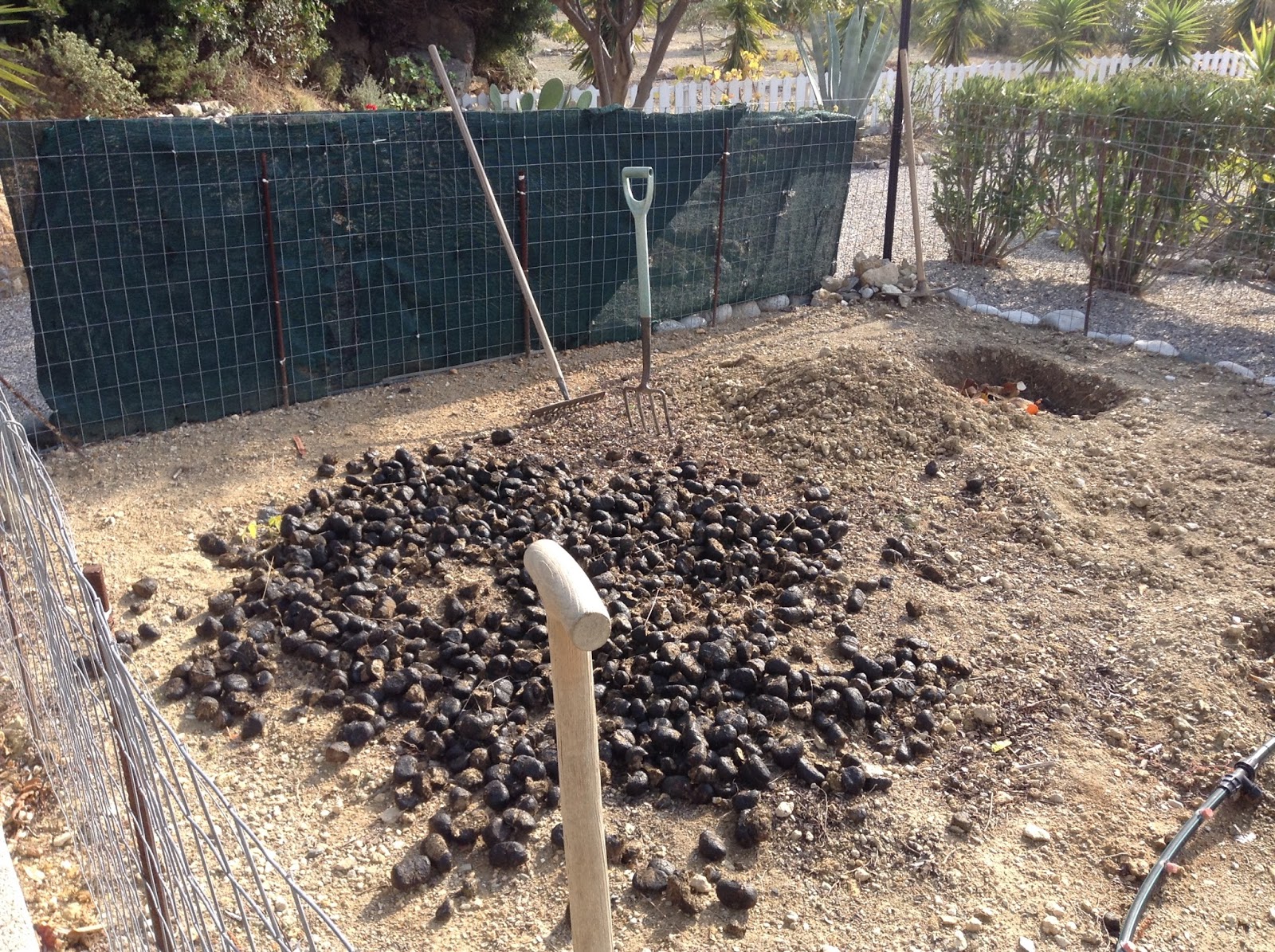
So, anyway, I bought a new laptop last week (wince) and had to nip down to Lardos on Tuesday to see if my friend and computer whizzo Panos could sort out a problem I had with the e-mail settings on it (another story. Believe me, it is. All sorted now though, but not by Panos, despite the fact that he's PDG generally with such things). So, there I was driving back up our kilometre-long lane when who should I come across pushing the wheelbarrow up the hill in the direction of the house but my better half. In the wheelbarrow was a very respectable load of fresh horse poo with a spade resting atop the whole pile.

The sight I encountered represented a deal of spade work and a substantial degree of physical labour on her part, and there's her suffering from a heavy cold too. Drawing up alongside her and lowering the window I expressed my admiration for her enterprise, whereupon she dropped the handles of the wheelbarrow, came around to my side of the car, removing her gardening gloves all the while and opened the car door. 

"You can do the rest, I'm knackered." She said and bade me exit the vehicle henceforth, forthwith, if not sooner. 

Now, I could have argued that I hadn't foreseen such an activity as part of my plan for the day; there are those that would have I'm sure. But I didn't have the heart. After all, prior to my returning she'd wheeled that barrow over half a kilometre down the lane, thrown  a hundredweight of the smelly stuff into it and begun wheeling it back, which represented an uphill push of the same distance. What can the decent chap do? He has to comply doesn't he? Scores a few points too chaps.

So, weeping (well, symbolically anyway) as I watched the car recede before me as she drove it on up to the house, I grabbed the handles of the wheelbarrow and began the trek. Actually, horse poo isn't all that heavy for its volume, unless you're wheeling it uphill all the time, in which case a certain Sisyphus comes to mind.

Reaching the front gates having worked up a very respectable sweat, I can tell you, I comforted myself with the thought that she'd no doubt have the coffee on to welcome me home.

No such luck. She was washing the car.

What a pleasant, bucolic scene eh?

Saturday, 12 December 2015

Spina-wrong-a, Part the First


Ever since I read Victoria Hislop's "The Island", some time before the Greeks made a TV serial out of it, I ...well, I should say we - have been curious about visiting the place. The Greek TV serial, which went out a few years ago now and is available in (as far as I understand it) abridged form on a DVD with English subtitles, was arguably the best piece of TV drama the Greeks have ever produced. But then, that's just my humble opinion of course.

The island in question, as no doubt you'll know, is Spinalonga and it served as a leper colony from 1903 until 1957, with the last resident finally leaving the island in 1962. Although Victoria Hislop's book is fiction, it is of course based around the true events of the time and is a truly heartrending tale. People living on the island of Crete for many years up until a cure was found for the dreaded disease lived in perpetual fear of catching it, with the inevitable prospect of being banished to the island for the rest of their lives.

As with so many people who've read the book, the desire to visit the island has been with us for some years and so, with the opportunity to visit and stay with friends on Crete, who live only half an hour's drive from Plaka, the village across from which Spinalonga stands, we got a bit excited about the whole adventure. Should have known better, this IS Greece after all.

We'd originally wanted to visit during the season, but were assured by our friends that they know a bloke who used to work on the island and he assured them that we'd be able to visit during November. OK, no sweat then, we went off season.

The day dawned for our expedition and our friends lent us their car for the day. This time we were going it alone after a few trips here and there with them. After several visits to Crete, during which we'd never been into Agios Nikolaus or Elounda, we were "right made up" (as Northerners would say) about the prospect. The weather all week had been kind, with only two periods of rain, both of which had been after dark. The day for our trip to the Island dawned sunny with cloudy patches, so we were very positive. First though, my wife insisted that we had to make a visit to the weekly Laiki (street market) which was within walking distance of our hosts' home. She and our host, Sylvia needed a dose of downmarket-downhome rummage-type retail therapy.

Reluctantly we trotted up the road, with me all the while watching my watch to see how much time we were losing from our planned excursion, to begin the excruciating "stroll" along the endless street where the market was being held. Pretty soon the two women had found a stall selling tops, skirts, leggings and all that other stuff that usually sends members of the female gender into paroxysms of delight and Timothy and I began hanging around, trying our hardest to put on expressions of mindless boredom in the hope of eliciting some sympathy. The vain hope I should say.


Of course, the sound of Greek music was wafting along the street from some bloke's stall selling dodgy CDs and even dodgier ghetto-blasters and thus my better half began showing her appreciation by dancing to it. This had the effect of making him turn up the volume even more to ear-splitting level, whereupon she danced all the more. I pretended not to notice...

Tim shows his apprehension at the prospect of purchases being undertaken. The women, of course, were oblivious.
You know, when women get into the zone in such circumstances, us blokes have no chance. In the end Tim and I stood together to one side for so long that people began approaching us, proffering cash in one hand for the garment they were holding in the other, thinking that we'd been there so long that we must be working there. Had we not been honest as the day is long we could have cleaned up.

Finally, after I'd tapped my watch for the umpteenth time and my wife had satisfied her primal homemaking urges by making a couple of well-chosen purchases, we agreed that it was time to get going and, catching the car keys that Tim tossed me, we bade our farewells and headed back to the car.

We headed for Plaka first, with the plan of coming back through Elounda and then to Ag. Nik. before heading home. It was probably about 1.30pm when we arrived at Plaka, under a clear blue sky and with the sea looking like the proverbial millpond. "Yes," we'd been told, "There will be boats going today, no worries." This from someone who had worked on the island remember.

As you'll know, in this country if someone says "no worries," then it's usually the time to worry. Driving through the village and catching glimpses of the island, only a few hundred yards offshore, we strained to see where the quayside was from which the boats would probably be going. Having parked the car and walked through to the front we found it. There before us was a stone quay, completely devoid of boats and none were visible across the other side at the tiny quay on the island either. Hmm.


Not far, is it.

Not that rough either, eh?

The breakwater above the quay can be seen bottom right. 
You know, when one imagines a deserted village, well one usually pictures what we were now seeing. There was hardly a soul anywhere. Well, there was a French couple ambling along the quayside, evidently doing what we were, looking for a boat. I ought to add that there were in fact several, but none of them was actually in the water. They were propped up on wooden blocks on top of the quay. There were also two women from Germany, also looking to see if they could make the crossing. We know, because later they asked us about what had happened at the small café on the front.

What did happen at a small café on the front? I'll tell you next time. Master of suspense, eh? Alfred Hitchcock eat your heart out.