For members of the Facebook group "A Good Greek Read" that I'm quite proud to have started a few years ago, I'd hazard a well-educated guess that the name Yvonne Payne is not going to be new. Yvonne is, of course, one of the four 'Admins" currently ensuring the smooth running of the page. Yvonne wrote her first novel, the epic and true tale of Kritsotopoula, a young girl whose heroics resulted in her going down in history as a heroine of the island of Crete, back in 2018, and its reception among readers has been very warm indeed, with 96% of its reviewers giving it four or five stars on its Amazon UK page.

Yvonne has since gone on to write a second novel, Rodanthe's Gift, plus a very good guide to Kritsa, her adopted home village on the island of Crete, which includes much more than simply information on what to find where. As its Amazon page says, "Explore Kritsa" is a book in which, "in an informal and lively style, Yvonne shares her month by month insights into Kritsa life and the local customs, food, history and culture. Yvonne also shares 15 of her favourite walks around the area, ranging from a gentle stroll to steep, uphill hikes.Whether your stay is a brief visit to the village, a holiday in the area, or you plan on making a home in Kritsa." ...this book will delight.
Thus, Yvonne well is qualified to be the next 'victim' in my occasional series of interviews with fellow writers on a Greek Theme. And so, I'm proud to produce what follows, an interview with fellow author and Grecophile, Yvonne Payne:
Where do you live?
Along with my husband, I spend my life between two small homes. One is an apartment in Swindon, Wiltshire in the UK, where we have easy access to family and walks in rolling green countryside. The other, our favourite, is a house in the traditional hillside village of Kritsa on the island of Crete.
Here we appreciate being part of the community and our walks are in rugged mountains and countryside, often with views of the sea. People say we’re lucky, but it took a lot of planning and compromise to achieve our preferred balance. Where we are lucky is to have the health to enjoy our chosen way of splitting the year.
What do you write about?

I write historical fiction based around my village of Kritsa. Bear with me and I’ll explain how this came about… Kritsa has a famous heroine called Rodanthe. Back in the time of Ottoman oppression a local Turk ruler had her abducted from her home in cruel circumstances. Somehow Rodanthe killed the man and escaped to the mountains wearing his clothes where she joined a group of rebels led by Captain Kazanis. She maintained her disguise as a young man and fought alongside her fellow rebels in a huge 1823 battle just outside of Kritsa. Severe battle wounds led to the discovery of Rodanthe’s true identity.
 Rodanthe’s family home in Kritsa is close to my house and as local villagers still hold an annual memorial for their ‘Kritsotopoula’, meaning Girl of Kritsa, I soon learnt her story. As with many folktales, local people share the legend of Kritsotopoula via an epic poem. I set about researching the life and times of Rodanthe to write a leaflet for village tourists. Then two questions kept turning over in my mind: 1. How did she maintain her disguise? 2. What equipped the daughter of a local priest to fight so bravely? When my research failed to find answers, my leaflet turned into a novel, "Kritsotopoula, Girl of Kritsa."
 This period in Cretan/Greek history was very turbulent and when I found out that Captain Kazanis, a key figure in my first book, had fought in the siege of Missolonghi on mainland Greece the result was my second novel, "Rodanthe’s Gift."
Now I’m hooked! My future novels will continue to have a basis of historical fact with the key action centred in Kritsa – I’ve discovered a wealth of information that will keep me busy for years.
Oh, and I should mention that I’ve recently published a non-fiction book, "Explore Kritsa," featuring 15 local walks.
How long does it take you to write a book?
"Kritsotopoula, Girl of Kritsa" evolved over several years as it grew into a novel needing several rewrites as I learnt more. By the time I wrote "Rodanthe’s Gift" I had a much clearer idea of what I wanted to achieve so it only took two years. I completed "Explore Kritsa" in less than a year using accumulated knowledge and walking routes that we’ve been enjoying for over eighteen years.
What do you enjoy most about writing?
As I write historical novels, the research is both essential and enjoyable. I strive to gain a good grasp of facts before weaving them into a story. This takes conversations, visiting sites, reading books and internet searches. I try to corroborate facts from at least two sources–then the inconsistencies and unanswered questions leave room for my imagination to take over. This phase can be fun for my husband too as it involves visits to new places, museums, walks to check feasible routes and, for "Rodanthe’s Gift," a holiday in Missolonghi, Greece.
I also relish the second rewrite as this phase brings characters to life and I also add in details like smells and taste.
How do you go about writing, that is to say, are you organised, do your research, disciplined, are you a messy sort who gets it done one way or another?
I guess you’d say messy as I flit about collecting a wide range of information as I never know what will be useful.
Look at this photo of a painting that I took during a visit to the museum in Missolonghi as an example.

Wikipedia informed me of a battle on a nearby island but this painting gave me a whole chapter for "Rodanthe’s Gift" and that couldn’t have happened without going to Missolonghi. My description of clothes worn by Lord Byron and a general are all taken from paintings in the museum. If I make it as real as possible for me then I think it adds to the reader’s experience too.
Where I am organised is in my use of a tool called Scrivener as it means I don’t have several notebooks on the go making it difficult to find information when required. It is as easy to use as Word but a quick click and drag alters the order or even which manuscript a piece is in. Once the draft is complete, it takes seconds to produce a Word document for editing. This allows me to have complete flexibility over how I store the information i.e. a screenshot of a webpage, photos, or a written scene between evolving characters that may or may not prove to be useful. At present I’ve got three story outlines on my Scrivener. No matter how much research I do before I start I always need to look up specific pieces of information while writing. For example, when writing "Rodanthe’s Gift" I had to look up limb amputation techniques in the 1820s – very gory!
By the time I’m ready to get on with the writing I know the characters and plot so well that I can write at any opportunity, I don’t work office hours or need to sit at a desk. However, that’s not as mechanical as it sounds, as characters, who are of course real to me, can take me in unexpected directions. I remember my husband being bemused to find me in tears when a much-loved character in Kritsotopoula died unexpectedly in horrible circumstances.
Which other authors do you read?
I have always chosen action and adventure stories where the setting is a key part of the inspiration behind them – Wilbur Smith and Ken Follett are two that spring to mind. I’ve read several of the books by Nikos Kazantzakis and my favourites are Christ Recrucified (the setting for much of the 1957 film was in Kritsa) and Captain Michalis (known as Freedom or Death in the UK). A book that seems to have less notice than it deserves is Birds Without Wings by Louis de Bernières set in a small community in south-west Anatolia at the end of the Ottoman Empire. The Carpet Weaver of Uşak by Kathryn Gauci is another great read in the same era.
I read many of the books featured in your Facebook group, A Good Greek Read. I knew I’d like your recent wartime book, Panayiota as you based it on fact and took me to an era I knew less about.
Apart from research, what do you enjoy most about the internet?
I love how it makes the world a smaller place. As a child I had pen friends in Australia, France and Canada. A grown-up version of this is blogging and social media sites like Facebook. It is possible to develop friendships and gain insights to life all around the world from the comfort of your armchair. Some people spend time reading magazines and flick through until they find an article that interests them and I do the same with blogs about travel, cooking, writing, and lifestyles. I’ve been fortunate to meet up with several bloggers and, as we’ve already something in common, it makes the basis of a good friendship.

Favourite Greek dish?
Traditional cooking methods turn a few humble vegetables into a feast. This is great for me as I chose not to eat meat and I’ve yet to find vegetable dish I dislike. If pushed to choose a favourite, I’d say vegetarian moussaka made with green lentils and aubergines. As well as eating out, I enjoy shopping for seasonal produce in the weekly Agios Nikolaos farmer’s market to recreate tasty dishes myself.
So, there you have it, Yvonne Payne's answers to my questions, giving quite an insight to the background behind the two interconnected novels that she's written so far, and a definite hint that there will be more where they came from. If you want to explore Yvonne's writings further, here are a few live links:
Website - https://kritsayvonne.com/
Amazon - https://www.amazon.co.uk/Yvonne-Payne/e/B00TSBPYSK
Facebook - https://www.facebook.com/kritsayvonne/
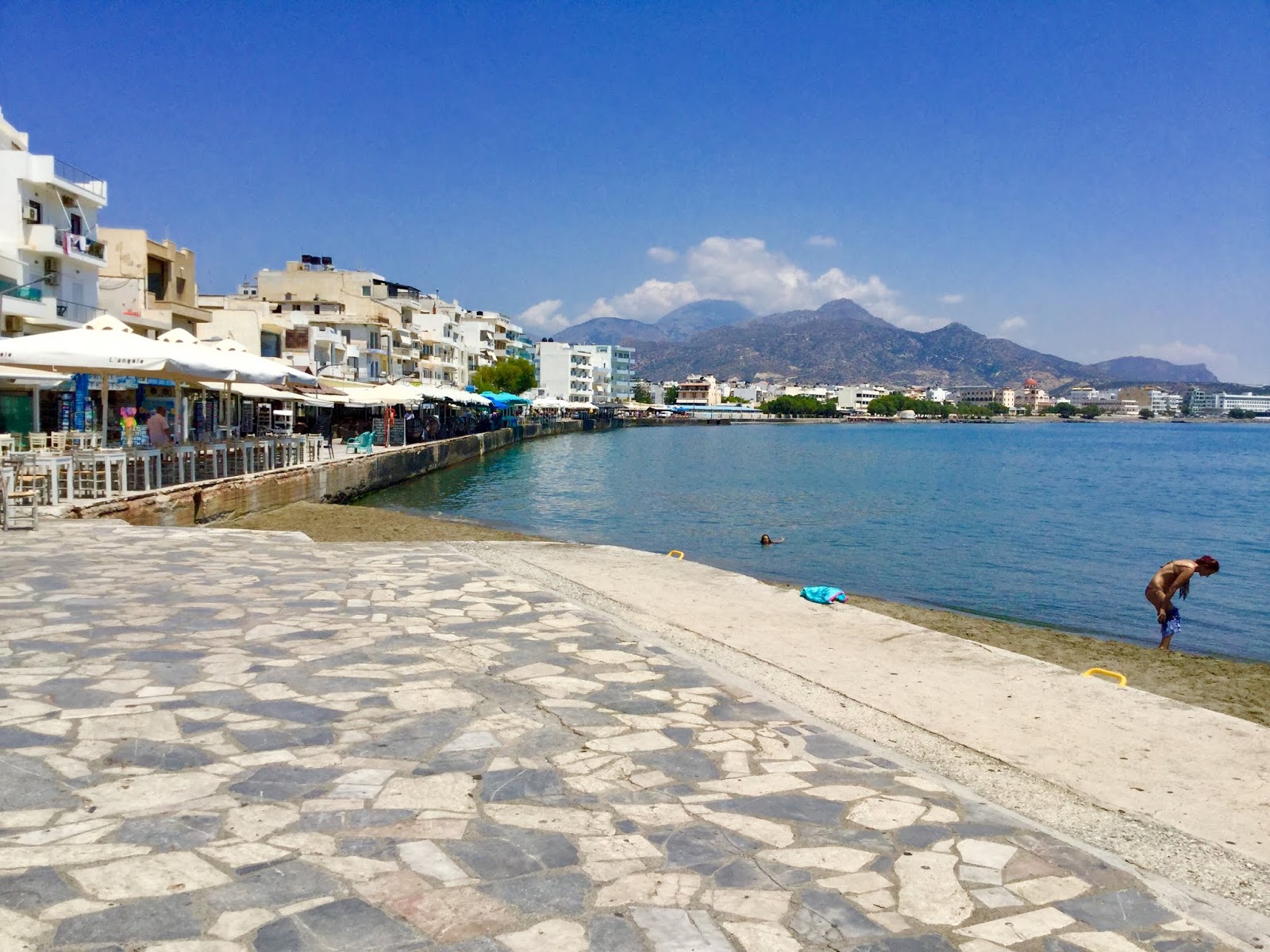
For the next post I shall be returning to a photo-heavy travelogue about our continuing stay in Ierapetra, in Southern Crete, not much more than a stone's throw, in fact, from Kritsa.

Yvonne has since gone on to write a second novel, Rodanthe's Gift, plus a very good guide to Kritsa, her adopted home village on the island of Crete, which includes much more than simply information on what to find where. As its Amazon page says, "Explore Kritsa" is a book in which, "in an informal and lively style, Yvonne shares her month by month insights into Kritsa life and the local customs, food, history and culture. Yvonne also shares 15 of her favourite walks around the area, ranging from a gentle stroll to steep, uphill hikes.Whether your stay is a brief visit to the village, a holiday in the area, or you plan on making a home in Kritsa." ...this book will delight.
Thus, Yvonne well is qualified to be the next 'victim' in my occasional series of interviews with fellow writers on a Greek Theme. And so, I'm proud to produce what follows, an interview with fellow author and Grecophile, Yvonne Payne:
Where do you live?
Along with my husband, I spend my life between two small homes. One is an apartment in Swindon, Wiltshire in the UK, where we have easy access to family and walks in rolling green countryside. The other, our favourite, is a house in the traditional hillside village of Kritsa on the island of Crete.
 |
| Kritsa scene |
Here we appreciate being part of the community and our walks are in rugged mountains and countryside, often with views of the sea. People say we’re lucky, but it took a lot of planning and compromise to achieve our preferred balance. Where we are lucky is to have the health to enjoy our chosen way of splitting the year.
What do you write about?

I write historical fiction based around my village of Kritsa. Bear with me and I’ll explain how this came about… Kritsa has a famous heroine called Rodanthe. Back in the time of Ottoman oppression a local Turk ruler had her abducted from her home in cruel circumstances. Somehow Rodanthe killed the man and escaped to the mountains wearing his clothes where she joined a group of rebels led by Captain Kazanis. She maintained her disguise as a young man and fought alongside her fellow rebels in a huge 1823 battle just outside of Kritsa. Severe battle wounds led to the discovery of Rodanthe’s true identity.
 Rodanthe’s family home in Kritsa is close to my house and as local villagers still hold an annual memorial for their ‘Kritsotopoula’, meaning Girl of Kritsa, I soon learnt her story. As with many folktales, local people share the legend of Kritsotopoula via an epic poem. I set about researching the life and times of Rodanthe to write a leaflet for village tourists. Then two questions kept turning over in my mind: 1. How did she maintain her disguise? 2. What equipped the daughter of a local priest to fight so bravely? When my research failed to find answers, my leaflet turned into a novel, "Kritsotopoula, Girl of Kritsa."
  This period in Cretan/Greek history was very turbulent and when I found out that Captain Kazanis, a key figure in my first book, had fought in the siege of Missolonghi on mainland Greece the result was my second novel, "Rodanthe’s Gift."
Now I’m hooked! My future novels will continue to have a basis of historical fact with the key action centred in Kritsa – I’ve discovered a wealth of information that will keep me busy for years.
Oh, and I should mention that I’ve recently published a non-fiction book, "Explore Kritsa," featuring 15 local walks.
How long does it take you to write a book?
"Kritsotopoula, Girl of Kritsa" evolved over several years as it grew into a novel needing several rewrites as I learnt more. By the time I wrote "Rodanthe’s Gift" I had a much clearer idea of what I wanted to achieve so it only took two years. I completed "Explore Kritsa" in less than a year using accumulated knowledge and walking routes that we’ve been enjoying for over eighteen years.
What do you enjoy most about writing?
As I write historical novels, the research is both essential and enjoyable. I strive to gain a good grasp of facts before weaving them into a story. This takes conversations, visiting sites, reading books and internet searches. I try to corroborate facts from at least two sources–then the inconsistencies and unanswered questions leave room for my imagination to take over. This phase can be fun for my husband too as it involves visits to new places, museums, walks to check feasible routes and, for "Rodanthe’s Gift," a holiday in Missolonghi, Greece.
I also relish the second rewrite as this phase brings characters to life and I also add in details like smells and taste.
How do you go about writing, that is to say, are you organised, do your research, disciplined, are you a messy sort who gets it done one way or another?
I guess you’d say messy as I flit about collecting a wide range of information as I never know what will be useful.
Look at this photo of a painting that I took during a visit to the museum in Missolonghi as an example.

Wikipedia informed me of a battle on a nearby island but this painting gave me a whole chapter for "Rodanthe’s Gift" and that couldn’t have happened without going to Missolonghi. My description of clothes worn by Lord Byron and a general are all taken from paintings in the museum. If I make it as real as possible for me then I think it adds to the reader’s experience too.
Where I am organised is in my use of a tool called Scrivener as it means I don’t have several notebooks on the go making it difficult to find information when required. It is as easy to use as Word but a quick click and drag alters the order or even which manuscript a piece is in. Once the draft is complete, it takes seconds to produce a Word document for editing. This allows me to have complete flexibility over how I store the information i.e. a screenshot of a webpage, photos, or a written scene between evolving characters that may or may not prove to be useful. At present I’ve got three story outlines on my Scrivener. No matter how much research I do before I start I always need to look up specific pieces of information while writing. For example, when writing "Rodanthe’s Gift" I had to look up limb amputation techniques in the 1820s – very gory!
By the time I’m ready to get on with the writing I know the characters and plot so well that I can write at any opportunity, I don’t work office hours or need to sit at a desk. However, that’s not as mechanical as it sounds, as characters, who are of course real to me, can take me in unexpected directions. I remember my husband being bemused to find me in tears when a much-loved character in Kritsotopoula died unexpectedly in horrible circumstances.
Which other authors do you read?
I have always chosen action and adventure stories where the setting is a key part of the inspiration behind them – Wilbur Smith and Ken Follett are two that spring to mind. I’ve read several of the books by Nikos Kazantzakis and my favourites are Christ Recrucified (the setting for much of the 1957 film was in Kritsa) and Captain Michalis (known as Freedom or Death in the UK). A book that seems to have less notice than it deserves is Birds Without Wings by Louis de Bernières set in a small community in south-west Anatolia at the end of the Ottoman Empire. The Carpet Weaver of Uşak by Kathryn Gauci is another great read in the same era.
I read many of the books featured in your Facebook group, A Good Greek Read. I knew I’d like your recent wartime book, Panayiota as you based it on fact and took me to an era I knew less about.
Apart from research, what do you enjoy most about the internet?
I love how it makes the world a smaller place. As a child I had pen friends in Australia, France and Canada. A grown-up version of this is blogging and social media sites like Facebook. It is possible to develop friendships and gain insights to life all around the world from the comfort of your armchair. Some people spend time reading magazines and flick through until they find an article that interests them and I do the same with blogs about travel, cooking, writing, and lifestyles. I’ve been fortunate to meet up with several bloggers and, as we’ve already something in common, it makes the basis of a good friendship.

Favourite Greek dish?
Traditional cooking methods turn a few humble vegetables into a feast. This is great for me as I chose not to eat meat and I’ve yet to find vegetable dish I dislike. If pushed to choose a favourite, I’d say vegetarian moussaka made with green lentils and aubergines. As well as eating out, I enjoy shopping for seasonal produce in the weekly Agios Nikolaos farmer’s market to recreate tasty dishes myself.
 |
| The memorial to Rodanthe, which stands in the village of Kritsa today. |
•
So, there you have it, Yvonne Payne's answers to my questions, giving quite an insight to the background behind the two interconnected novels that she's written so far, and a definite hint that there will be more where they came from. If you want to explore Yvonne's writings further, here are a few live links:
Website - https://kritsayvonne.com/
Amazon - https://www.amazon.co.uk/Yvonne-Payne/e/B00TSBPYSK
Facebook - https://www.facebook.com/kritsayvonne/
•
For the next post I shall be returning to a photo-heavy travelogue about our continuing stay in Ierapetra, in Southern Crete, not much more than a stone's throw, in fact, from Kritsa.